Iran-Saudi tensions: 6 nations label embassy attack terrorism




Story highlights
- The foreign ministers say Iran is inciting unrest with its "hostile and provocative statements"
- Protesters angry about a Shiite cleric's execution stormed the Saudi embassy in Tehran last weekend
- Members of the Gulf Cooperation Council meet in Riyadh, agree to call embassy attack terrorism
Riyadh, Saudi Arabia (CNN)A six-nation Middle Eastern alliance agreed Saturday to characterize the recent attack on Saudi Arabia's embassy in Tehran as an act of terror -- strong language that marks an even further escalation in a tiff that has embroiled the region for days.
Foreign ministers from the six Gulf Cooperation Council met in the Saudi Arabian capital of Riyadh, after which alliance Secretary-General Abdul Latif Zayani read a statement indicating that the nations agreed to label last weekend's incident as terrorism.
Zayani himself a few days ago referred to the Saudi Embassy as a terrorist act, so this terminology isn't entirely new. Still, it is significant in that the six GCC countries -- Bahrain, Kuwait, Oman, Qatar, Saudi Arabia and the United Arab Emirates -- are now officially on the same page.
It also suggests countries in the region aren't acceding to requests from the United Nations, United States and other officials to tone down their rhetoric and refocus on other issues, like peacefully ending Syria's civil war and dealing with ISIS.
Iranian President: Anger over executions 'only natural'
Protesters stormed and set ablaze the embassy in Tehran starting last Saturday, hours after Saudi Arabia executed 47 people, including prominent Shiite cleric Sheikh Nimr al-Nimr, on terrorism charges.

10 photos: Protest in Tehran after Saudis execute cleric
Smoke billows from the windows of the burning Saudi Embassy on January 2. A CNN producer in Tehran said some protesters made it inside the building, setting fire and ransacking some records.
Hide Caption
6 of 10

10 photos: Protest in Tehran after Saudis execute cleric
A firefighter sprays water on the flames on January 2 in Tehran, Iran, a Shiite-majority nation, issued a statement deploring the execution and warning that Saudi Arabia would pay a heavy price for its policies.
Hide Caption
7 of 10

10 photos: Protest in Tehran after Saudis execute cleric
Iranian protesters gather outside the Saudi Embassy in Tehranon January 2. Saudi Arabia said it executed "terrorists" and told Iran to stay out of its internal affairs.
Hide Caption
8 of 10

10 photos: Protest in Tehran after Saudis execute cleric
Several protesters were arrested, police officers at the embassy told CNN.
Hide Caption
9 of 10

10 photos: Protest in Tehran after Saudis execute cleric
There was some damage near the back of the embassy building, witnesses and a police officer said. None of the Saudi diplomatic staff was in the embassy at the time.
Hide Caption
10 of 10

10 photos: Protest in Tehran after Saudis execute cleric
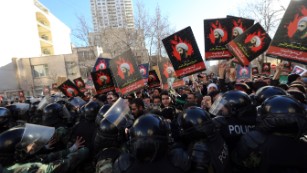
Iranian protesters hold portraits of prominent Shiite Muslim cleric Nimr al-Nimr as they confront riot police during a demonstration against his execution by Saudi authorities on Sunday, January 3, outside the Saudi embassy in Tehran, Iran. Saudi Foreign Minister Adel al-Jubeir told reporters that Saudi Arabia is severing ties with Iran after an attack on the embassy.
Hide Caption
1 of 10

10 photos: Protest in Tehran after Saudis execute cleric
Tehran's police chief Gen. Hossein Sajedinia, center right, tries to disperse protesters in front of Saudi Arabia's Embassy in Tehran on January 3.
Hide Caption
2 of 10

10 photos: Protest in Tehran after Saudis execute cleric
Iranian demonstrators burn representations of the U.S. and Israeli flags during a demonstration in front of the Saudi Arabian Embassy in Tehran on January 3.
Hide Caption
3 of 10

10 photos: Protest in Tehran after Saudis execute cleric
Iranian security guards Saudi Arabia's embassy in Tehran while a group of demonstrators gathered to protest on January 3.
Hide Caption
4 of 10

10 photos: Protest in Tehran after Saudis execute cleric
Protesters set fire to the Saudi Embassy in Tehran, Iran, on Saturday, January 2, during a demonstration against the execution of prominent Shiite Muslim cleric Nimr al-Nimr by Saudi authorities. Nimr was a driving force of the protests that broke out in 2011 in Saudi Arabia's east, an oil-rich region where the Shiite minority of an estimated 2 million people complains of marginalization.
Hide Caption
5 of 10
10 photos: Protest in Tehran after Saudis execute cleric
Smoke billows from the windows of the burning Saudi Embassy on January 2. A CNN producer in Tehran said some protesters made it inside the building, setting fire and ransacking some records.
Hide Caption
6 of 10
10 photos: Protest in Tehran after Saudis execute cleric
A firefighter sprays water on the flames on January 2 in Tehran, Iran, a Shiite-majority nation, issued a statement deploring the execution and warning that Saudi Arabia would pay a heavy price for its policies.
Hide Caption
7 of 10
10 photos: Protest in Tehran after Saudis execute cleric
Iranian protesters gather outside the Saudi Embassy in Tehranon January 2. Saudi Arabia said it executed "terrorists" and told Iran to stay out of its internal affairs.
Hide Caption
8 of 10
10 photos: Protest in Tehran after Saudis execute cleric
Several protesters were arrested, police officers at the embassy told CNN.
Hide Caption
9 of 10
10 photos: Protest in Tehran after Saudis execute cleric
There was some damage near the back of the embassy building, witnesses and a police officer said. None of the Saudi diplomatic staff was in the embassy at the time.
Hide Caption
10 of 10
10 photos: Protest in Tehran after Saudis execute cleric
Iranian protesters hold portraits of prominent Shiite Muslim cleric Nimr al-Nimr as they confront riot police during a demonstration against his execution by Saudi authorities on Sunday, January 3, outside the Saudi embassy in Tehran, Iran. Saudi Foreign Minister Adel al-Jubeir told reporters that Saudi Arabia is severing ties with Iran after an attack on the embassy.
Hide Caption
1 of 10
10 photos: Protest in Tehran after Saudis execute cleric
Tehran's police chief Gen. Hossein Sajedinia, center right, tries to disperse protesters in front of Saudi Arabia's Embassy in Tehran on January 3.
Hide Caption
2 of 10
10 photos: Protest in Tehran after Saudis execute cleric
Iranian demonstrators burn representations of the U.S. and Israeli flags during a demonstration in front of the Saudi Arabian Embassy in Tehran on January 3.
Hide Caption
3 of 10
10 photos: Protest in Tehran after Saudis execute cleric
Iranian security guards Saudi Arabia's embassy in Tehran while a group of demonstrators gathered to protest on January 3.
Hide Caption
4 of 10
10 photos: Protest in Tehran after Saudis execute cleric
Protesters set fire to the Saudi Embassy in Tehran, Iran, on Saturday, January 2, during a demonstration against the execution of prominent Shiite Muslim cleric Nimr al-Nimr by Saudi authorities. Nimr was a driving force of the protests that broke out in 2011 in Saudi Arabia's east, an oil-rich region where the Shiite minority of an estimated 2 million people complains of marginalization.
Hide Caption
5 of 10


That attack spurred Saudi Arabia to sever official ties with Iran, its longtime regional rival. Several other countries -- most of them led by and/or containing mostly Sunni Muslims, like Saudi Arabia, as opposed to Shiite-led Iran -- joined in. In that respect, this spat continues the schism that happened 14 centuries ago when Sunnis and Shiites split over who should succeed the Prophet Mohammed as Islam's leader.
Iran, though, has stood its ground -- even banningpilgrimages to Mecca and Medina as well as Saudi imports. President Hassan Rouhani called the angry reaction to Nimr's killing "only natural" and slammed Saudi Arabia for severing ties in response.
"Of course, the Saudi government, in order to cover up its crime of beheading a religious leader, has resorted to a strange measure and has severed its ties with the Islamic Republic," Rouhani said, according to Iran's state-run Press TV. "Undoubtedly, such moves will never hide that great crime."
Ministers accuse Iran of 'direct incitements'
The Gulf ministers who met Saturday in Riyadh, though, together insisted that Iran is in the wrong -- not just because of the embassy attacks specifically, but due to its actions and comments criticizing the Saudi executions.
According to the official Saudi Press Agency, the GCC ministers condemned not only the embassy attack but what it called "the Iranian blatant interventions in the internal affairs of the Kingdom of Saudi Arabia."
That report called "Iranian hostile and provocative statement on the judicial rulings implements (in Saudi Arabia) against a number of terrorists" as "direct incitements for launching attacks on the diplomatic missions."
The same council also raised other gripes against Tehran, like its "continued occupation of ... three United Arab Emirates islands, ... spread of sectarian strife, support for terrorist organizations and incitement to undermine security and stability in GCC countries."
The SPA report concluded, "The GCC Ministerial Council urged the international community to take necessary measures to compel Iran to respect the principle of good neighborliness, to stop its activities destabilizing the region, to stop its support for terrorism, to not interfere in the internal affairs of the GCC countries and the region's countries, and to not use or threaten to use force."
CNN's Nic Robertson reported from Riyadh, and CNN's Greg Botelho reported and wrote from Atlanta. CNN's Jon Jensen contributed to this report.


No comments:
Post a Comment