Swooning for Saudi Arabia
The Republican candidates claim Arab dictators have brought stability to the Middle East. Is that really true?
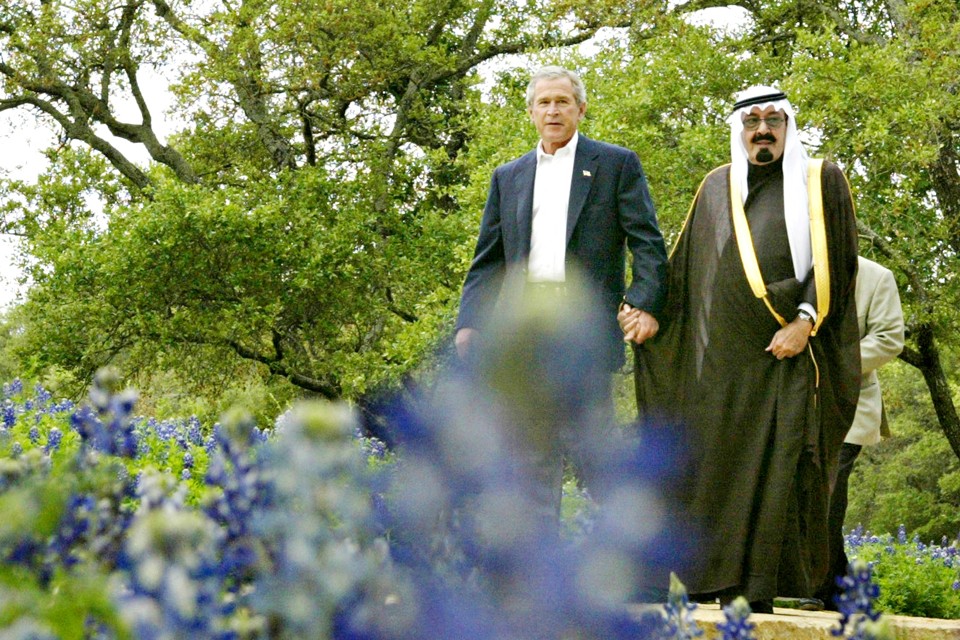
But there’s a problem: George W. Bush wasn’t entirely wrong. The very autocrats whom Republicans now praise for maintaining stability are actually breeding the opposite.
Look at the events of the last few days. Last Saturday, the Saudi regime executed Nimr al-Nimr, an activist for the rights of Saudi Arabia’s Shiites, who have long been oppressed in the kingdom. Saudi officials claimed Nimr had advocated violence against the state, but released no evidence. More likely, his real offense was disparaging the late Prince Nayef bin Abdulaziz, whose son, Muhammad bin Nayef, now runs the Saudi Interior Ministry, which oversaw Nimr’s execution.
Ayatollah Ali Khamenei, the leader of Iran’s Shia theocracy, responded with typically overblown rhetoric. (“God’s hand of retaliation will grip the neck of Saudi politicians.”) And enraged Iranians ransacked Saudi Arabia’s embassy in Tehran and its consulate in Mashhad. But after that, according to The New York Times, Iran’s leaders begantaking “steps to prevent the dispute from escalating further.” They arrested 40 anti-Saudi demonstrators. Iran’s president, Hassan Rouhani, called the attacks on Saudi facilities “not acceptable” and demanded that his government’s interior, judiciary, and intelligence ministries, which he does not entirely control, protect Saudi officials.
But the Saudis refused to deescalate. They cut diplomatic and trade ties with Iran and appear to have influenced some of their Sunni allies to follow suit. In so doing, they have likely prolonged the monstrous civil war in Syria, since without an understanding between Tehran and Riyadh on the future of Assad, a peace deal is virtually impossible.
Then there’s Saudi Arabia’s close ally in Egypt, President Sisi, a man often praised by GOP presidential candidates. Sisi has brought “stability” to his country via horrific violence. On a single day in 2013, his forces killed more than 800 protesters, including women and children, in what Vox has called “one of the deadliest single-day mass killings in modern history.” He’s also banned the political wing of the Muslim Brotherhood, the party that won the free election he overturned in a coup.
The result has been a rebirth of jihadist terrorism against the Egyptian state. Inthe words of the Egyptian democracy activist Ahmed Maher, Sisi’s mass imprisonment of his political critics is “turning the people arrested by mistake who don’t belong to any movement into jihadists. Moreover, Muslim Brotherhood members are gradually becoming radicalized, since they suffer from inhumane treatment in the prisons. … Extremism found a foothold in Egypt because of Sisi’s brutality and authoritarianism.”
Recognizing that Bush identified a genuine problem—dictatorship can breed jihadist terrorism by leaving oppressed people no peaceful avenue to express their discontent—does not mean he responded to it well. After America’s experiences in Iraq and Libya, GOP candidates are right to be skeptical of regime change.
But it’s one thing to overthrow an authoritarian regime and another to egg it on. In their fervor to appear tougher than Barack Obama against Iran, Republican candidates have given Saudi Arabia a blank check to act as recklessly as it wants. Asked about Nimr’s execution, Chris Christie declared that he had “no sympathy for the Iranians.” Marco Rubio said “our response should be to stand with our allies.” For the Florida senator, standing with the royals in Riyadh even means sending U.S. special forces to help fight their disastrous, immoral war in Yemen, something he proposed doing last May.

While abandoning George W. Bush’s focus on democratization, today’s GOP candidates have retained his Manichaean thinking. “Radical Islam” now serves the same purpose “axis of evil” did more than a decade go. As in 2003, hawkish politicians have constructed a category based less on Middle Eastern realities than on their own political preconceptions and needs. Everyone who falls inside it (Iran, the Muslim Brotherhood) is evil and must be shunned, if not crushed. Everyone who falls outside it (King Salman, General Sisi, Benjamin Netanyahu) is virtuous and deserves unreserved support, no matter how destructive their actions.
The reality is that while the United States should certainly combat ISIS and al-Qaeda, what the Middle East needs is not an intensified cold war between the forces of light and the forces of darkness, as imagined by Ted Cruz, but a series of political compromises that help end the civil wars that are traumatizing the region. The more America’s allies impede those compromises, the less they should be considered allies at all.


No comments:
Post a Comment